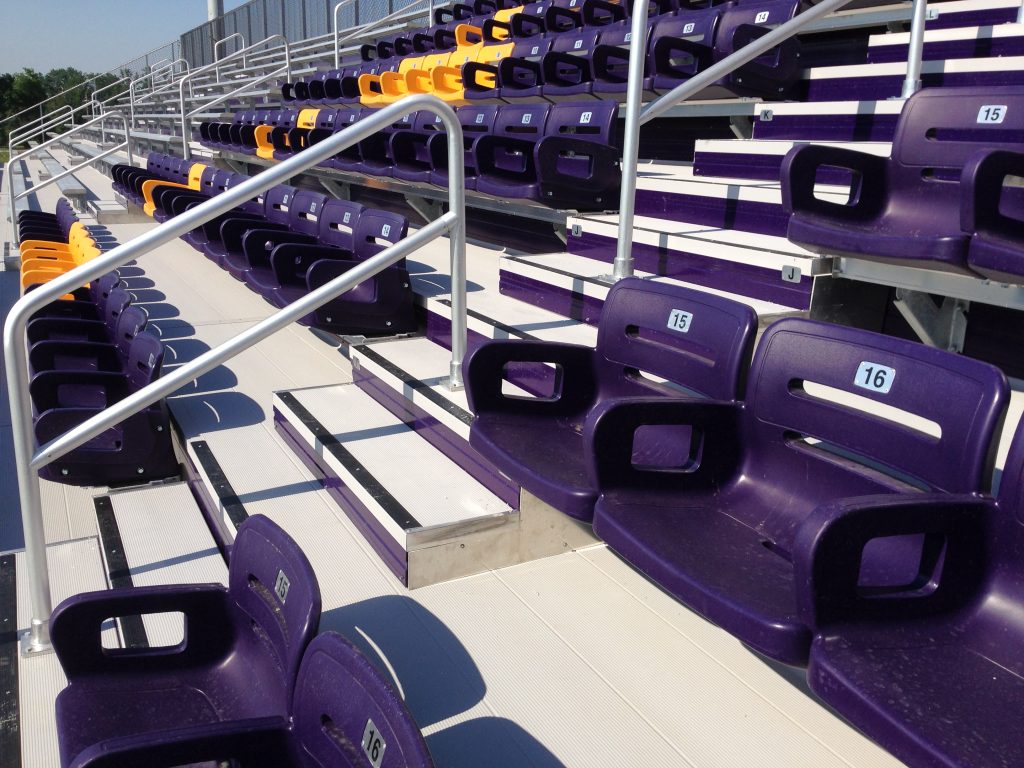
KEY CONSIDERATIONS WHEN SELECTING ALUMINUM DECKING SYSTEM FOR YOUR NEXT STADIUM DESIGN
Surface Treatments and Their Impact on Safety, Durability, Aesthetics and Performance
Historically, mill finished aluminum has been the default standard for aluminum decking in stadium construction. However, expectations have evolved significantly, with growing demand for decking systems that deliver on safety, durability, aesthetics, and long-term performance.
One of the most critical decisions in this process is the surface treatment applied to the aluminum decking.
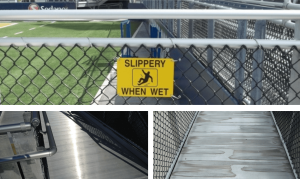
Traditional mill finish aluminum presents several well-documented challenges: it becomes slippery when wet, reflects substantial sunlight glare, and is prone to oxidation staining over time.
Among these factors, slip resistance is paramount, as it directly impacts spectator safety and liability exposure. However, performance expectations now extend beyond safety alone—facility owners are also prioritizing maintenance efficiency, longevity, and visual appeal.
Why Welded Aluminum Deck Systems Lead the Market
When evaluating deck construction types, welded aluminum deck systems consistently outperform alternative designs, including interlocking deck systems, in both functionality and long-term reliability.
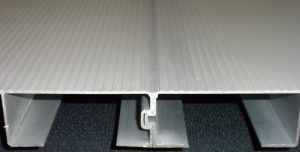
Our premium welded system incorporates a raised traction ribbed profile, engineered specifically to enhance slip resistance. Unlike rounded or shallow patterns, each rib is formed with a distinct 90-degree edge, which cuts through water surface tension underfoot. This design significantly improves traction, particularly in wet conditions where safety risks are highest.
Additionally, our welded systems provide greater decking coverage per plank, maximizing usable surface area while maintaining structural integrity. With a full 1 ¾” thick plank profile, this configuration delivers a robust, high-performance walking surface that stands apart from lighter or segmented alternatives.
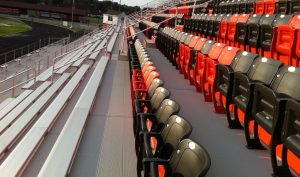
From a water management standpoint, our welded deck features a sloped design that functions similarly to a shingled roof system, channeling water efficiently away from seating areas. This prevents pooling and reduces the likelihood of slip hazards, staining, and dirt and debris accumulation between individual decking boards on interlocking systems.
Structural Integrity and Thermal Performance
One of the key technical advantages of welded decking lies in its material compatibility and thermal behavior. The filler material used in the welding process is specifically selected to match the expansion characteristics of the base aluminum extrusions.
As a result:
- The deck panel expands and contracts uniformly
- There is no measurable differential movement between planks
- The system avoids stress points that can lead to cracking or failure
This uniformity is critical in environments exposed to extreme temperature fluctuations.
Limitations of Alternative Decking Systems
Some competing systems utilize internal gutter designs embedded within the deck planks to capture and redirect water. While conceptually appealing, these systems introduce several operational challenges:
- Debris accumulation (dirt, leaves, etc.) frequently clogs internal channels
- Reduced drainage efficiency over time
- Water pooling beneath seating areas when clogged
- Increased risk of slips, staining, and mildew formation
Additionally, because these systems typically feature a flat walking surface, they lack the inherent water shed benefits of a sloped design, further compounding safety concerns.
Evaluating Deck Finish Options: Mill Finish v. Textured Thermo-Bonded Finish (Preferred Solution)
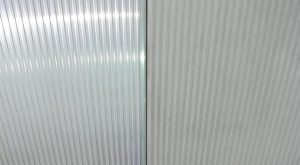
Mill Finish (above left, baseline option)
- Lower upfront cost
- Limited inherent slip resistance
- Susceptible to oxidation staining
- High glare in sunlight
While widely used historically, mill finish does not meet many modern expectations for safety or aesthetics.
Textured Thermo-Bonded Finish (above right, preferred solution)
The most effective and balanced solution available today is our textured, thermo-bonded surface coating.
This process involves:
- Electrostatic application of the coating
- Thermo-bonding at high temperatures for extended durations
- Creation of a sealed, durable, and textured surface
The result is a finish that simultaneously addresses all major performance concerns.
Key Advantages:
- Effective oxidation resistance
Prevents unsightly staining by sealing the aluminum surface from environmental exposure - Enhanced slip resistance
Textured coating improves footing in both wet and dry conditions - Low maintenance
Surface naturally sheds dirt and allows rainwater to assist in cleaning - Cost efficiency
More economical than multi-step finishing systems - Faster production timelines
Single-step application reduces lead time
Integrated Performance: System + Finish
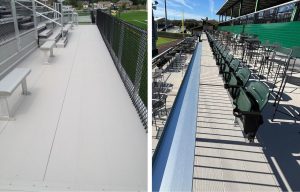
The optimal stadium decking solution is not just about selecting a structure or a coating in isolation—it’s about how the two systems work together.
A welded aluminum deck paired with a thermo-bonded textured finish delivers:
- Industry-leading slip resistance
- Superior water management
- Long-term durability with minimal maintenance
- Clean, uniform appearance over time
- Proven performance across diverse climates
A Proven Approach to Stadium Decking
With decades of innovation in aluminum and steel stadia systems, Dant Clayton has consistently advanced the standard for spectator seating infrastructure. Through rigorous engineering, precision manufacturing, and a commitment to material science, the welded decking and thermo-bonded slip and stain resistant finish systems are designed to meet the evolving demands of modern venues.
The result is a decking solution that is functionally superior and engineered for longevity, safety, and aesthetic performance—ensuring facility owners can confidently meet the expectations of today’s spectators and tomorrow’s standards.